Thursday, June 16, 2011

AN AUDIENCE AT THE VATICAN AND MORE, by Charlene C. Duline


I have been blessed to see two of our Popes in person; one I saw two times. Now, in Rome again, I was going to see Pope Benedict XVI. Dee’s archbishop in Anchorage wrote for tickets for us, and when we picked up our tickets we were told that we must be special because our tickets were for the area on the same level as the Pope. The audience was to begin at 10:30 a.m. I was excited and wide awake and ready to get up at 6 a.m., but remained quiet until shortly before 7 a.m. We arrived at St. Peter’s around 8:30 a.m., thanks to a taxi driver who was good, but kept me gasping with his near hits. No, those were not near misses, they were definitely near hits!

At St. Peter’s we went through security and passed thousands of people already there. Our seats were up on a dais close to the Pope. I put on my huge straw hat and sunscreen as the sun bore down. Some people had umbrellas up shielding them from the sun. We knew they knew they were going to have to lower those umbrellas when the Pope arrived. It got hotter and hotter. Several bishops came in along with their friends.

We saw a young priest enter with an older priest. The senior man went to the area closest to the Pope. The junior man came to our row looking for a seat. Apparently he was told the seats were all taken. He turned away dejected and went to the other side to sit where he could only see the back of the Pope’s head. There was an empty seat next to me, and Dee went over and brought him back. He was a young Cistercian who was the private secretary to the Abbott of the order who now sat near the Pope’s chair. I was delighted that he joined us because it gave Dee somebody else to talk to since she had exhausted the family from Texas on the other side of us. Just kidding...sorta!


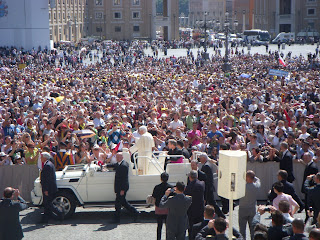
And suddenly people at the front began standing, and like a wave, people in row after row stood and there in his Pope mobile was the Vicar of Christ himself. Pope Benedict XVI stood waving and smiling, and the applause broke out and didn’t stop. He went up and down row after row, and smiled as if he was as thrilled as we were. Maybe he was. Finally the car drove right up to the dais and the Pope walked to his chair. The readings began. They were about Sodom and Gomorrah. And then the Pope spoke about our society, and in so many words, apologized again for the abuse by some priests. Methinks he has apologized enough because every time he does several hundred false claimants reach for the phone to call Jeffrey Anderson or some other lowlife attorney for some spending money to the detriment of some innocent priests!


Greetings began in various languages. The Pope always added his own special message when the presenter finished speaking. There was one language that we could not identify. Dee said she knew the Pope was not going to speak in that language. Wrong! Ah, what a Pope we have!

I took a number of items to be blessed by the Pope and I was holding them in both hands. I was barely able to make the Sign of the Cross. But I was blessed along with my “family” which includes my family of broken priests, my “other parents” – Mama Gladys and Daddy Dougie, my sisters, and if Ebony had been here, she too would have gotten a blessing. Those items are very, very special and most will be given to my “family” members. Unfortunately I can only share prayer cards with my priests in prison.

It was a magical day even though there were thousands of pilgrims seated in St. Peter’s Square, and hundreds more standing around. Pope Benedict always has a serene expression on his face and when he smiles, his face seems to light up. An aura of holiness surrounds him. He appears to be a man of peace, and a man at peace. What a burden he carries. There is a room in the Vatican called the “Crying Room.” It is the room into which the Pope-designate goes to ponder the burden the cardinals have asked him to undertake – to guide the Roman Catholics of the world. He meditates and prays in this room. Then he dresses in his papal garb, and comes out to lead the Church. It is said that every man has come out of that room in tears. I can understand why.

The first pope I saw was Pope Paul VI who visited the United Nations in 1965. He requested a special audience with the common folk, i.e., clerical staff and others who were not members of a diplomatic delegation to the UN. I was thrilled until I learned that each office would have a certain number of tickets allotted, and we would have to draw for a ticket. My boss was the head of two departments: Archives and Records Retirement. I was the only Catholic in my office, and I desperately wanted to win a ticket. Shortly after the drawing, my boss’ secretary from Archives called me. Frieda was Jewish. She said, “Charlene, I just drew a ticket to see the Pope. I want to see him, but I know it would mean so much to you to hear him, so I want to give you my ticket.” What an offer! I was overwhelmed, but I was able to tell Frieda that I too had drawn a ticket. She rejoiced with me, and together, the two of us, a Catholic and a Jew, attended the special meeting sought by Pope Paul VI. She was as excited as I was to see and hear the Pope. During his talk he told us that he brought each of us a present. I could hardly wait to receive my present.

After two weeks and no present, I called the office of the Secretary-General to ask about it. I was told that the presents would be given out shortly. I waited another two weeks and I called again. This time I said I was going to contact the Pope and tell him the UN was not giving us our presents. And this time I was told the truth: the Pope had not brought enough medals for the staff, and they had to figure out a diplomat way to tell him, and then he had to have additional medals made. So they held onto the medals the Pope had brought with him, and waited for him to send the rest of them. I waited not exactly patiently, but I waited. And then came the day we received our presents!

Each bronze medal was nestled in a small, suede-like bag. It is about two inches in diameter. On one side of the medal is the Pope’s coat of arms and the words Paulus .VI. Pont. VI. UN.4.Oct.1965 [Paul VI Supreme Pontiff, United Nations, 4 October, 1965]. On the other side is a burning bush and the words “Amoris Alumna Pax,” student of love and peace. What a thrill it was for all of us at the UN to receive a bronze medal, a blessed gift from the Pope himself. I had my medal encased, and I now wear it around my neck on special occasions. It is one of my most precious possessions… a gift from a Pope, the Vicar of Christ.
Two years later I visited Rome for the first time enroute to East Pakistan for a two year UN assignment. I managed to get a ticket for an audience with Paul VI, and imagine my surprise to find myself in an audience of several thousands. It was still a treat to see the pontiff.

I have been blessed three times to see two different Popes. The one I yearned to see was Blessed Pope John Paul II. He was my favorite because he made everyone feel special, went everywhere, met all kinds of people, forgave his would-be killer, kissed the ground when he arrived in a country (how often I have wanted to do that in sheer relief at landing safely!), and everybody loved him, even people who were not Catholic. He suffered much before he died. He showed us how to die although few of us, if any, will die with thousands of people beneath our window praying for us, wanting us to remain with them, but knowing that God waited for him on the other side. Blessed John Paul almost gave his life for us. It was our Blessed Mother who took him in her arms that day and saved him. No, selfishly I didn’t want him to leave us, but he deserved to rest in peace with our Lord. I doubt that there will ever be another Pope with such a scintillating personality, deep spirituality, obvious joie de vivre, and who will be so loved, especially by the youth. In their words, “The Pope rocks!” High acclaim indeed.

Monday, June 6, 2011

PILGRIMAGE TO ROME AND STOPS ALONG THE WAY

When I told people that I was taking a cruise to Italy they immediately asked what cruise ship left from Indy. They doubted that my carrier of choice, Royal Caribbean, would cruise up or down our White River, the only body of water anywhere near us. They were right. We were going to arrive at our carrier in Ft. Lauderdale via the old Greyhound bus. My penchant for traveling by any mode except planes has just about done me in. My traveling companion, Dee, and I took a 22 plus hour bus trip to Ft. Lauderdale. The driving was fine, but getting off and on the bus got tiresome fast! It was get off for them to clean the bus, or get off because it’s a rest stop (then let me rest!), or get off to change buses (once in Atlanta).

We arrived safely in Florida. During check in at the hotel, Dee started talking to folks – as she is wont to do! - who were also going to Europe, on another ship. In our room Dee announced that the couple wanted us to go out to dinner with them. I grimaced, and said I was going to get a shower and climb into bed to rest. I felt that my clothes should be peeled off me, and I didn’t know if I should brush or shave my teeth. They felt fuzzy. I wanted no contact with anybody until I had a shower, bed, and some rest in order to regain my good humor which had been absent since I left home.

When Dee returned from dinner hours later, I was resting in bed and watching the news about the killing of Osama bin Laden. My last thought before I slept was: the bastard’s death raises the price on every American’s head. Next morning I was rested, but my mood had not improved. As we approached the pier we saw our ship - it dwarfed all the other ships. It was the Royal Caribbean’s Navigator of the Seas – a H U G E ship/city. This is a ship with cafes and shops along the Royal Promenade, a five-story theatre, an ice-skating rink, three-story dining room, a basketball court, etc.

NAVIGATOR OF THE SEAS
The boarding went smoothly. I was recovering from a cold and checked the “yes” box on the ship’s form asking if one had a cold. A nurse was dispatched to take my temperature, check ears and nose, to be sure that I was not going to contaminate other passengers. On previous cruises I noticed that crew members were stationed at the doorway of all restaurants, to be sure that passengers entering would use the hand sanitizer. There were no crew members keeping watch this time, and most passengers used the sanitizers, but some simply walked by it.

Our stateroom was ready and I was ready for it. Still exhausted from the bus trip, I wanted to sleep for a week, but adventure awaited! There was no life jacket drill for which I was grateful. I usually just put the life jacket around my neck and wait for an attendant to get it hooked correctly. If I ever have to use one, methinks I’ll just go down with the ship. We met our cabin attendant, a delightful young man from Jamaica, and we began exploring our home city for the next 13 nights.

At dinner we met our tablemates, a delightful elderly couple from Finland who now live in Florida. They were going home for the summer. We had wonderful waiters as I’ve always experienced on Royal Caribbean. After dinner Dee and I hit the casino and the slot machines. We didn’t do too badly.

Up fairly early the next day, well, earlier than I’m accustomed to. Dee was ready to continue exploring. I quickly discovered that whenever we left our stateroom, we had to walk about a mile to get anywhere! Dee was positively giddy because of this unexpected – not to mention unwanted – opportunity for me to exercise. It seemed that everything was at the end of the ship where we were not, and we were in what they called the “middle.” There were a lot of activities and things to do, but they were all early in the morning. That eliminated them for me. On our third night there was a Welcome Reception, a photo op with the Captain of the ship, and champagne.

We met people – how could we not when Dee is determined to meet any and everybody in the vicinity, who pass by, stand in a line, or are on the elevator. In view of the bin Laden killing, I asked her to stop telling people that I am a retired U.S. diplomat. I pointed out that U.S. diplomats would be first on the hit list of bin Laden’s foot soldiers. As we sat sipping our champagne and chatting with a Canadian guy, she went into her usual monologue about my background. Her voice carries and she cannot speak softly. I noticed we had gotten the attention of a group at a nearby table. When we stood to leave one of the women called me over to ask if I really was a retired diplomat and where I had served. Sigh…

I dreaded going anywhere because I knew we would always encounter people, and Dee would start raving about my book and my background. I joke that she’s the best agent I never had. I do appreciate her help, but I had asked her before the trip to allow me to travel in peace. I don’t like being on display ALL the time – and it is ALL the time when I’m with her.

Via our ship’s newspaper, “The Compass,” we learned there was a Catholic priest onboard. We planned to attend his 8 a.m. Mass on Day 4. When our 7 a.m. wake-up call came, the ship was rocking like a cradle. We grabbed our Sea-Band wristbands to stop the motion sickness before it began, and went back to sleep.

Day 5 arrived and escargots were on the dinner menu as an appetizer and as a main course. I live for this on every Royal Caribbean cruise! I ordered snails for my appetizer and snails for my main dish. Dee ordered them as an appetizer. Hers arrived and she dived in. To her credit, she shared one with me. My mouth watered. What can I say? I love French food, especially escargots. Suddenly the head waiter came over and said to me, “I’m sorry, but all the escargots are gone.” Surely he jested. I sat there waiting for him to smile and to bring my escargots. He then said they had run out of snails because so many people ordered them. I was flabbergasted! Later I realized that Americans were in the minority on this ship, most of the passengers were Europeans and, of course, they would enjoy escargots. The waiter apologized profusely, but there was no consoling me. He said they would have snails the next evening. I didn’t believe him. He asked me to order something else, but I didn’t want anything else. He then brought me two coupes of large shrimp with cocktail sauce. I ate the six, and was sharing the other coupe when the head waiter placed before me two plates of escargots! I began beaming. He said he had searched high and low for those two plates. He had gone to all of the specialty restaurants to find them. He never had a more appreciative diner.

We finally got to Mass on Mother’s Day. It was celebrated by Fr. David Remy from the Diocese of Pensacola-Tallahassee. Several hundred Catholics attended, and it was a lovely service with an excellent homily.

I forgot to attend the Welcome Back Party for previous RC guests. I was tired and simply forgot. I didn’t forget the next formal night which was the Captain’s Invitation-Only Reception where the champagne flowed. There was also a special invitation-only event to visit the ice-skating rink. We were told to “dress warmly.” As guests arrived, waiters walked around with trays of champagne, beer, red and white wine, and mixed drinks. Hors d’oeuvres were also available. There was a short talk by the Captain about the ice skating rink, and an introduction to some of their stars on ice. The Captain also shared some information about the newest RC ship which will be available in 2013. It will be another behemoth and will carry 5000 passengers (as opposed to our Navigator of the Seas which carried 3,000 passengers and over 1,000 crew. That means one will have to walk twice as far as we walked on this mammoth. I can hardly wait! We attended the ice show which was spectacular. Even with the rough seas, the skaters performed flawlessly!

Each night there was a performance in the theatre. There were singers, comedians, along with the RC dancers and singers. Wonderful performances. The only night I skipped the performance was the tribute to the Beatles. Sorry, I’m not a Beatles fan.

The Captain announced one day that the next morning at 6 a.m. we would see the Rock of Gibraltar. I woke up at 5 and again at 6. I could barely see the balcony. Back to sleep. Later we learned that the wrong information had been given out; it was the next day that we would see the Rock. Or whoever was up at 6 a.m. would see it.

NIGHTMARE IN CIVITAVECCHIA
The ship posted information that the train station in the port city of Civitavecchia was about “three blocks” from the ship. Because of the amount of luggage we had, we opted to take the shuttle bus to the train station to get the train for Rome. We rode for about 20 min. before reaching the train station. We passed one family walking, or trying to. I prayed that a taxi would drive by for them. Information in English was often incorrect or inaccurate. [We thought of offering our services to teach English to most of the crew who were lacking in English in exchange for free cruises. We’ve already selected the ports we want to visit.]

We arrived at the train station – all several hundreds of us - to get a train into Rome. Dee got in line to buy our tickets while I guarded the five pieces of luggage. She had warned me about gypsies and pickpockets so I was on guard. The tiny station was mobbed. With tickets in hand, we went out to the platform and stood for about 20 min. At that time word began circulating that our train would leave from the platform on the other side of the tracks. We had to descend a long flight of stairs and up a steep flight to the other platform. Dee pulled the two heaviest suitcases, and I had the others. Halfway down the steps my right arm gave out. Dee asked a man descending the stairs to help us. He did, and even took the bags up the stairs to the other side. We were so grateful. He would not hear of accepting any money from us. God bless him.

We hoped we were on the right platform. A Canadian couple wanted to help us but feared we could all be separated. More people arrived and pushed us further back on the platform. The Canadian couple protested loudly that the newcomers should get behind those who were there first. That fell on deaf ears. Finally the train arrived and we all crowded on. We managed to get ourselves and our suitcases into the tiny standing area between the cars, and there we stood. We could not move. More people jammed on. At some stations we refused to open the doors to allow others to even try to cram on. Two men we had to knock about to get on the train turned out to be quite helpful. I gave them hell earlier. They didn’t get angry, just said it was a crazy situation and if everybody (mainly me methinks!) remained calm, we would all be happier. Ha! At the Rome station they got our bags off first, and we parted with smiles and thanks.

We had finally arrived in the Eternal City. Look out, Pope Benedict, here we come!

Friday, April 8, 2011

ANOTHER FALLEN ANGEL IS LEAVING US

Another of my fallen angels is dying, a priest who was thrown out of our Church, who was so loved, but was accused, who did so many wonderful things before and after, and now he is heaven-bound. Until his health began to fail, he worked very hard to establish a place where other men go for solace and soul restoration; a place where they can use their hands to help build a chapel, or walk among the gentle llamas. It is a place where priests hold retreats, or visit to be alone as they soul-search, or they can be with other men who, like themselves, need a respite from what has become a daily grind – being a priest.

 It is also a place where Father gives men fresh out of jail or prison a second chance and a place to stay, and only asks in return that they do some chores on the ranch. When several of us visited his ranch, he took me to meet his herd of llamas knowing of my great love for animals. The llamas greeted us, and I lovingly rubbed their furry faces, and met a baby llama born the day before. Father’s dog who had accompanied us saw the new addition to the llama family and he wanted to meet the baby. But the baby was skittish and wanted no parts of the dog. The baby’s mother lay on the ground contentedly chewing her cud. Whenever the dog got too close the baby would jump over her mother to the other side. The mother was not concerned because she knew the dog meant no harm to them. Baby was not of the same mind. It was a funny scenario. Finally we left, taking the dog with us in the truck and returned to the house. 

There were several buildings on the property in various stages of construction. Father could not do it all, and when he had helping hands, they would often begin other projects. The result was a number of projects half finished or half done – viewers’ choice. That evening Father celebrated Mass in his tiny chapel. He warned us that mice in the unfinished ceiling sometimes peeked at visitors during Mass. I looked forward to seeing them, but they never showed. This priest is dearly loved by all who know him. He has walked among many of you. 

 I met Father a few years ago when he concelebrated at a memorial Mass for another fallen angel in New Mexico. There were four priests concelebrating that day, along with three women in attendance. I will never forget that Mass for one of the first priests I met via letters. He wanted nothing more than to apologize to those he abused, but that was not possible. He suffered from his past behavior, but only God could judge him. Very few showed him the love and compassion that our Church teaches us to do. That priest died of neglect – sheer neglect from the prison staff, and indifference from his diocese – and I vowed to never let that happen again. 

 Back to the wonderful priest I am writing about. Occasionally he and I spoke on the phone. He always referred to me as, “Excellency” because of my diplomatic career. I called him the same. He would tell me that the llamas were asking for me. They were so precious and he was so gentle with them, along with the two dogs and a cat who recently joined the household. Father’s health has been declining, and when we were unable to reach him, we were concerned. The same thing happened near the end of last year. We learned that he had been in the hospital. Now we wondered if he had been hospitalized again. 

Dee, who has known Father for many years, finally contacted the local church to see if anybody there had news of Father. It was from the church secretary that we learned that Father is very, very sick. Dee called him and then she called me and gave me the news. She also managed to speak to a nurse who visits Father daily. I just had a brief conversation with Father on the phone. His voice is very weak and he spoke with difficulty. I tried desperately to fight back tears. At one point he said to me, “It’s not that bad, it’s just that I am not used to being sick.” It is not that bad, no, it’s far worse than he knows. For the past two or three years Father has battled a number of illnesses. We are told that that this will be his final battle.

 A nurse visits daily and tries to keep him comfortable. Two friends are there looking after him, and other old friends are pouring in to see him. He knows he is loved. This is reminiscent of the death of Bishop Pat Ziemann not long ago. Dee and I spoke to him the day before he died. I remember Dee telling him that her husband, John, would greet him at Heaven’s gate. 

 Through tears I told him I loved him and was praying for him. I wanted to ask for his blessing, but I knew he was too weak. And so another of my fallen angels goes forth to meet our God. I know his heart and God knows his soul. We all know that he is ready to meet his Savior, but what a loss to those of us who know and love him. 

After we spoke, I hung up the telephone, bowed my head and talked tearfully to our Lord. I asked Him to take His beloved priest into His arms, that he not suffer, that he be received into Heaven where he can pray for his brother priests. I thanked God for allowing me to know this gentle, loving man who is forever a priest in that sacred Order of Melchizedek. May God shed His grace on us, one and all.

Sunday, April 3, 2011

ONE MUST NOT LIE TO GOD!

Something sort of funny happened today. They say it’s not nice to fool Mother Nature, well, it definitely not nice to try to fool God. During Mass today I felt so moved by the homily, and in such a good mood that I told our Lord I was not going to holler and cuss other drivers on the road, that I was going to be a good, good person on my way back home.

I wasn’t bothered by the usual drivers who drive fast and get right on your rear, and then have to jam on the brakes. I was not going to lose my temper. I stopped at a store to pick up a few items and then I was homeward bound.

My next stop was at the post office. I had some envelopes to mail and I was going to drop them into the drive-up mail box. There was a car ahead of me and I saw a little old, old woman standing outside her car putting mail in the mailbox. She then got back in her car and sat there. She had to know that a car was behind her, besides my headlights were on. I sat and she sat. I suddenly noticed that she was looking in a mirror and fixing her hair! Whoa! Without a second thought I hit my horn!! There went my good intention and it was all her fault! She sat for another few seconds and before my inner woman came completely out of me, she drove off. I was furious! I drove up to the mailbox, reached out to put my mail in, and a gust of wind took one envelope out of my hand and into the air it went! Meanwhile, a car pulled up behind me. Without a thought to that waiting car, I had to get out of my car, find the damned envelope, catch it between wind gusts, and place it in the mailbox. I stomped back to my car, crawled in and moved a few feet so that I could attach my seat belt. And then I guffawed! I suddenly remembered my promise to God! He had thumped my forehead! He was teaching me a lesson! Well done, Lord, well done.

In my own defense, I must admit my feelings that old, old people should not be allowed to drive, especially if they can barely see over the steering wheel, want to creep along at 30 mph, and can barely see in general! They should not be on the roads! Nothing gets my ire up more than some old person in some huge car, just meandering down the road as if they have no place to go and no time to be there. I am 73, but far from old, and besides, I definitely am not one of those slow old drivers!

Awhile back, I was at a stop light. My light turned green. Meanwhile, 3 old coots were driving trucks, and one turned left in front of me when his light was yellow. The second old coot turned on his red light, and the third one was coming out into the street when I laid on my horn, and began moving. What the hell was going on? Didn’t they see the stop lights? What did they think the lights were there for? Old drivers are positively scary! They oughta be kept off the streets!

When I moved into my new neighborhood a few years ago, I was driving slowly down a street and looking around. An old man driving behind me was furious. In the rear view mirror I could see him gesturing wildly and his mouth was moving and I knew he didn't learn those words in Sunday School. I ignored him. Finally, he pulled out from behind me and into the left lane.
He yelled, “You’re supposed to be doing 45 miles an hour!”
I yelled back, “No, 45 is the limit. I can drive 10 MPH if I want to! And I want to!”
He pulled ahead like he had been shot out of a cannon, jumped back into my lane, and made a right turn at the corner.

See what I mean? Old people are terrible drivers, run red lights, and holler at people. I only honk my horn. I must admit that I holler at them inside my car, but they can’t hear me. And that is indeed a good thing!

Tuesday, March 29, 2011

AN ODE TO PEACE AND QUIET...ALL GONE!

AN ODE TO PEACE AND QUIET … ALL GONE
(With apologies to all poets.)


A few years ago I moved into this quiet haven seemingly designed for seniors and those who wanted no mowing, watering, snow-shoveling, etc.

After a few years, we began to notice the gradual increase of small children. The Board of Directors received complaints about kids running, jumping, bumping and the like, all in the second floor units.

In my building we reveled in our peace and quiet. I never heard one sound from those who lived over me. And then a couple moved into the condo over me. When they walk, the walls shake. It sounded as if giants walked overhead. I gritted my teeth.

And then little ones began arriving. My peace was over. I could even tell who was walking at any given moment. I named them Big Foot, Little Big Foot, and the Kid.
A neighbor and I recently commiserated with each other. A child lives over her also. Kids never walk when they can run. Running through an apartment doesn’t make much sense, but it’s what they do. Parents never think of the people who live under them until it’s brought to their attention that their lil darlings are disturbing other residents. And then the parents resent being asked to control their children and stop annoying the hell out of other residents!

I have enjoyed my little haven these 16 years, but now I fear I’ll have to find another haven. I will let somebody else “enjoy” the elephants overhead. I can only pray that when prospective buyers come to see my unit, the folks upstairs will be out or asleep. Nobody is going to willingly live underneath what sounds like a herd of elephants? Have you noticed that people with children almost always live in upstairs units? Should be a law against it!

Friday, December 31, 2010

THE DEATH OF A PRIEST

As 2010 comes to an end, my mind, my heart, and my thoughts go to the priests who are no longer with us, to those who took their own lives when their lives began crumbling around them due to an accusation. Imagine the angst of a priest who commits suicide. A priest, of all people, knows the seriousness of suicide; he also knows that God forgives us all our sins, and yet when faced with such a crushing accusation of sexual abuse, he thinks that not even God will forgive him. Not only does he think this, but he knows with certainty that his Church will never forgive him. Such an accusation is akin to a death sentence. The accused priest instantly becomes a leper, an untouchable, a throw-away.

His bishop, like Pilate, immediately washes his hands of the troublesome priest lest the hate groups march on him. Terrified of retribution, he hides and points out that the Church has gotten rid of this priest. The rest he leaves to the courts, the paid mouthpieces, and the slimy accusers. His only question is how much money does the accuser want. Whatever happened to “innocent until proven guilty”? Our bishops threw out that concept when they agreed to hand over without question any amount of money an accuser demands. They have done a grave injustice to every priest who wears the collar of the Catholic Church. Every priest in the Catholic Church is at risk. Anyone can accuse a priest, and without any proof whatsoever, his bishop will immediately order him out of the rectory and into the night, caring not where the priest goes or if he even has a place to go to. Oh, it is so sad.

Gluttonous attorneys and people with no morals are having a field day accusing priests, and raking in the money of parishioners. The blood of every priest who has committed suicide after being accused, guilty or innocent, is on the hands of lying accusers and their money-grubbing attorneys. It is blood money. An old adage says a fool and his money are soon parted. Amend that to say a fool and his money are quickly parted. It is said that “God don’t like ugly and He ain’t set on pretty.” Some of us should be very, very concerned about Judgment Day.
We can only pray that someday the bishops who do not help their brother priests, will follow the lead of the few good bishops who DO visit priests in prison, who DO write to priests in prison, who DO what Christ would do. I correspond with a number of priests in prison, and they tell me how grateful they are when they are visited by a bishop, or receive a letter from a bishop. They are so grateful that every one in the Catholic Church has not abandoned them.

I often cry when I read their letters. They thank me for “being Christ” to them. I am not worthy of such an honor. Each of the Christmas letters and cards I received from priests in prison, was full of thanks and praise for my concern for them and my faithfulness in writing, talking to them on the telephone, sending books, etc. Their letters always bring tears because I am only doing what our Lord said we are to do. How can I do less? As long as I have breath in me, I will not abandon our priests in prison. God loves them and so do I, each and every one. I don’t need to know their sins, God knows. I only know that they need prayers and a helping hand, and we reach out to each other. I consider it a blessing to have them in my life.

Our Church has been changed forever. It has done a disservice to many of its priests. There is no way for an innocent priest to regain his reputation after it has been announced at every Sunday Mass that he has been suspended for sexual abuse, guilty or not. Why did none of the bishops think of that when they signed off on the Dallas Charter? There will never be a time when a litigious attorney will not find somebody willing to lie, accuse a priest, and demand money. This will go on and on and on … until every Catholic Church is completely and utterly penniless. Maybe, just maybe then, the greedy attorneys, their clients, SNAP, and VOTF will be satisfied. Somehow, I doubt it.

Father Gordon J. MacRae of www.TheseStoneWalls.com writes eloquently of what priests suffer who are accused:


THE DARK NIGHT OF A PRIESTLY SOUL
By Rev. Gordon J. MacRae

“It seems to the soul in this night that it is being carried out of itself by afflictions . . . This night is a painful disturbance involving many fears, imaginings, and struggles within a man. Due to the apprehension and feeling of his miseries, he suspects that he is lost and that his blessings are gone forever.” (St. John of the Cross, The Dark Night, Ch. 9, 5, 7)

In his new book, Secular Sabotage (FaithWords, 2009), Catholic League President Bill Donohue wrote masterfully of the front lines of the culture war between the sacred and the secular. More than at any other time of the year, these two forces face off in the Christmas season in a culture seemingly at war with its own soul.

When I was a younger priest, the period from Thanksgiving to New Year’s Day always felt like a mixed blessing. The demands on a parish priest at Christmas are very great. A spiritual observance of Advent and Christmas is an exhausting challenge against an ever-advancing tide of secular materialism.

We priests experience in the Christmas season both the hope of the Incarnation and the limits of our human condition. It’s a spiritually vulnerable time that can heighten the intensity of loneliness, the pain of personal struggles and alienation, the agony of loss. Christmas can bring with it a deeply felt awareness of suffering and shadow, of spiritual and emotional vulnerability. It’s a time when, for some, the spring of hope can feel a lot more like the winter of despair.

When I was asked to write for Priests in Crisis at Christmas, I felt very limited in scope. I was about to mark my sixteenth Christmas in prison. Frankly, Christmas in here is simply not what it is out there. It’s a time when the people around me suffer a great deal. Those with families and children are separated from them by impenetrable prison walls. Those who are alone have their loneliness magnified by the onslaught of Christmas imagery.

I set out to write something warm and fuzzy for other priests at Christmas, but, well, it just wasn’t coming. I kept being drawn to some unfinished business, something that has gnawed at me for seven years. Justice requires that I try to make some spiritual sense of it. Now is the time. What I am about to write may be very painful for some to read. Whether you are a lay Catholic, or a priest, deacon, or religious, if you are reading this, I beg you to read carefully and understand.

Seven years ago today, on December 29, 2002, a brother priest in my diocese took his own life. Father Richard Lower was 57 years old. He was a popular and very gifted – and giving – priest and human being. Father Lower had served Our Lady of Fatima Parish in New London, New Hampshire for the previous thirteen years, and he was much beloved by his parish family. There was a lot that happened in Father Lower’s personal life over the preceding year. He had undergone his sixth painful back surgery. Then he developed septicemia for which he was hospitalized again. Father Lower’s mother died that November. These factors, and likely others that are unknown, left Father Lower physically, emotionally, and spiritually bereft to face the newest terror that was to enter his life two days after Christmas seven years ago.

NO CRUELER TYRANNIES
On December 27th, every priest’s worst modern nightmare was visited upon Father Richard Lower. He was informed by a diocesan official that a claim of sexual abuse had been lodged against him from thirty years earlier in 1972. Father Lower had never been previously accused. The accusation stood alone, but was enough – three decades later – to abruptly end a life of ministry and priestly self-giving.
Based on the single, uncorroborated thirty-year-old claim, Father Lower was informed that the police would be notified. In accordance with the “zero tolerance” policy of the U.S. Bishops’ new Charter for the Protection of Children and Young People, he was suspended from ministry and told that he must immediately vacate the parish he had served for thirteen years.

As was every priest in the Diocese of Manchester, Father Lower was also painfully aware of an announcement from his bishop and diocese made just weeks earlier. In an unprecedented agreement between the Diocese and the State announced in December, 2002, the files and details of every accusation against any priest – regardless from however long ago – would be included in a vast public release of documents in March of 2003. Any privacy rights of the individual priests under canon or civil law were summarily discarded and waived by the signing of this agreement.

Two days after celebrating Christ’s birth with the parish community he loved and served for thirteen years, Father Richard Lower lived Christ’s scourging, and was about to live the Scandal of the Cross in a way for which he had no defense. Succumbing to the darkest night of his soul, this good priest, walking alone in the valley of darkness, took his own life.

Father Lower died without having either acknowledged or denied the 30-year-old claim brought against him. He died alone, apparently having reached out to no one. He left no note. A lot of people – including a number of priests – lamented that they could only imagine what Father Lower went through in those three days after Christmas. 
I did not have to imagine anything. I knew exactly what he went through: the feeling of living in a vacuum, the sense of isolation, the feeling of powerlessness, the utter despair of never, ever being able to erase the scarlet letter indelibly marking the accused – guilty and innocent alike; the sheer impossibility of any defense after the passage of three decades; the overwhelming despair of exactly what Saint John of the Cross described in his Dark Night of the Soul:
“Due to the apprehension and feeling of his miseries, he suspects that
he is lost and that his blessings are gone forever.”

Do you know what you were doing on any given day in 1972? Can you document your answer? If you’re a Catholic priest, you may have to, and your very life may depend on it. Innocent or guilty, what Father Richard Lower faced in those days after Christmas seven years ago is a hopelessness unlike anything one could imagine without going through it. It was for good reason that Dorothy Rabinowitz entitled her 2005 book about the power of false sex abuse claims, No Crueler Tyrannies: Accusation, False Witness, and Other Terrors of Our Times.

In my prison cell a few days after Christmas in 2002, my eyes closed when I read the headline story. I knew Father Richard Lower. He was a priest I admired, and one of only three priests of my Diocese who ever wrote to me in prison.
Nine months before he was accused, Father Lower wrote to another friend lamenting the terror being visited upon other priests. When so many others looked away in silence, Father Lower wrote courageously to challenge the lack of due process and presumption of guilt when other priests were accused. From an April, 2002 letter of Father Lower to a friend:
“The minute a man is accused, he’s immediately suspended. He is forced to
leave his rectory
within the hour. The result of this horrendous policy is that
the priest is seen to be
guilty until proven innocent.”

With reference to his back surgery and other pressures, Father Lower reacted to the media attack that had so consumed the priesthood that year. In the same letter, he wrote: 
“With all the bad press the Church has received lately, it is very difficult
to either work as a priest in public or even to recuperate as a priest …
As always, the press has had a heyday with this topic and reported
things whether true or untrue. Because the Church did not handle
it properly in the past, they now have a policy of no tolerance …
Another fallout to the scandal is that a ‘witch hunt’ has begun.
It feels like all priests are suspects and no one can be trusted.
Please pray for us.”

After Father Lower’s tragic death, an official of the Diocese of Manchester acknowledged the truth of exactly what Father Lower-feared, but also defended the policy. In a local news article, Father Edward Arsenault was quoted thusly:
“In parish communities where priests have been put on leave,
parishioners already
believe them guilty. I know there is some expense. 
But I am confident that our policy
is fair.”

TREASURE AND TRAGEDY
It has been documented that some twenty-five American Catholic priests have taken their lives after being accused. Some in the news media have implied that their despair is evidence of guilt. How sad and shallow.

People of justice and conscience have expressed concern that our use of the death penalty in criminal cases may have resulted in the execution of some innocent men. Given the hundreds of innocent men who have been wrongly imprisoned for rape and other crimes, then exonerated by retesting DNA evidence, the concern is justified.

But isn’t it just as likely that some innocent priests were on that list of twenty-five who lost hope? Isn’t it possible that what some of them despaired most was the apparent end of justice and fairness, the sheer impossibility of defending themselves? Believe me on this, accusations of sexual abuse are far more devastating for the innocent than for the guilty. I believe that others who have been falsely accused will corroborate this fact.

Absent clear and convincing evidence – and there has been none – I presume Father Richard Lower’s innocence. It’s what the United States Constitution bids me to do. It’s what the rule of law – both Church and civil – bids me to do, and it’s what the Gospel bids me to do. To presume anything else, absent evidence to the contrary, would belie a heart too jaded to claim to live justly and fairly, to claim to live the Gospel of Mercy.

After the tragic suicide of another priest, Father William Rosensteel, in June, 2007, Catholic columnist Matt C. Abbott published a powerful statement on http://www.RenewAmerica.com. It was from an unnamed supporter of Father Rosensteel:

“We need to remember how important a person’s good name is. To knowingly
 harm a person’s
reputation without cause and clear evidence is a serious violation of the Eighth
Commandment. The consequences of such violations are far-reaching and irreversible.
Even a priest who is known to be guilty of the crime of child abuse should not be
required to forfeit his life to satisfy attorneys, insurance companies, the media and
plaintiffs. How much more is this true of a priest whose ‘case’ has not yet been
decided?”
(RenewAmerica, August 7, 2007)

As I held the local newspaper in my hand on December 30, 2002, with a headline declaring the scandal of a priest’s suicide, I would have given anything to be on that wooded path that day with Father Lower at what he feared was the end of all things he held dear. I now wish I had the means to write in 2002 what I am writing here. It may have saved this good priest’s life. Even now there is hope – for Father Lower and for us.

First, there’s a lesson to be learned. It’s especially important that priests and lay people reach out to priests burdened with the tyranny of decades-old claims of abuse. In “The Sacred Priesthood,” an essay for the Year of the Priest Father John Zuhlsdorf wrote:
“The sacred priesthood is the common treasure and responsibility of the whole Church.”

Doesn’t that treasure warrant the benefit of the doubt for priests accused? Doesn’t it call us to support them with our words, our prayers, our mercy, and – if needed – our forgiveness?
“Today, the Church prays for persons who have taken their own lives” (Catechism of the Catholic Church 2283) recognizing that people who commit suicide suffer from anguish that can mitigate moral responsibility. I don’t think anyone can look justly at what happened to Father Lower and not see anguish there.

This Year of the Priest is a time to have hope for Father Richard Lower’s soul, and, from our practice of mercy, for ourselves. We owe it to him and other priests who lost all hope to assist them still with our prayers and Masses, with our Gospel mandate to be merciful. We owe it to our spiritual brothers and fathers in the priesthood to resolve to never again let another priest walk alone through the valley of darkness.

For my brother, Father Richard Lower:

“Softly and gently, dearly-ransomed soul,
In my most loving arms I now enfold thee,
And, o’er the
penal waters, as they roll,
I poise thee, and I lower thee, and hold thee.
And carefully I dip
thee in the lake,
And thou, without a sob or a resistance,
Dost through the flood thy rapid passage take,
Sinking deep, deeper, into the dim distance.
Angels, to whom the willing task is given,
Shall tend, and nurse, and lull thee, as thou liest;
And Masses on the earth and prayers in heaven,
Shall aid thee at the throne of the most Highest.
Farewell, but not forever! Brother dear,
Be brave and patient on thy bed of sorrow;
Swiftly shall pass thy night of trial here,
And I will come and wake thee on the morrow.”

John Henry Cardinal Newman,
Conclusion: “The Dream of Gerontius.” 


Fr. Gordon MacRae writes weekly for http://www.TheseStoneWalls.com. His writings from prison have also appeared in First Things, The Catholic Response, Catalyst, and many online Catholic venues. The above article was adapted from an article previously published by Fr. MacRae at www.PriestsinCrisis.com. 

Tuesday, December 7, 2010

ANOTHER DAY IN PARADISE....

ANOTHER DAY IN PARADISE

Problems cannot be solved at the same level of
awareness that created them.
Albert Einstein


[We’ve had torrential rains these past few days (before the snows began), and it reminded me very much of the kind of rains in the tropics.

[Warning: this was written in Panama, in anger, unrelenting heat, and fear. The language is mine, all mine!]

Another day in paradise is what I said to myself during the umpteenth day of rain when leather shoes, purses and everything else was covered with mildew due to constant dampness; when the power went out taking the air-conditioning with it; when I couldn’t get water from the tap because the pressure was too low; when I bathed in dirty water for two days in a row; when bomb threats forced me to flee the office; when I was sick and didn’t know which end to throw over the toilet first, and just when I thought things could get no worse, they did.

We’re not talking Peace Corps here; we’re talking the Diplomatic Service, the U.S. Foreign Service. The American public thinks we live in mansions, have servants waiting on us, drink champagne for breakfast, and do little else. Ha! We live in some wretched conditions, compounded by stiflying heat, snakes – the two-legged kind and the slithering kind, and every other critter known to man that flies or crawls; uncooperative government officials, and then the real kicker now – a hurricane.

It was October 18, and Hurricane Joan was heading toward Panama. Our boss said we should stock up on water and get out the flashlights because the radio reported that power and water would probably go. He said that we would know whether or not to go into work the next day. I suppose if the wind is blowing down everything in sight that’ll be a clue to stay at home. What next? We’ve had an attempted coup; a regime in power that we refuse to recognize; the constitutional president is in hiding; yellow fever is back in the country; dengue fever is on the way with no protection against it; Americans are on everybody’s hit list, and then up jumps a friggin’ hurricane! At home I dutifully filled the two bathtubs and every vessel with water. The Southern Command Network said there would be a “little” rain for most of the next day. I thought that was probably an understatement. I knew in my heart of hearts that it would be raining polecats the next day! The least bit of rain and the damn streets were flooded and we plowed – and I do mean plowed – through the water.

It didn’t help that I was right on the ocean. The waves had been dashing the hell out of the rocks ever since I got home that evening. When Hurricane Gilbert was nowhere near Panama, we caught hell. My apartment was alive and everything shook all night long – the doors, the windows, and me. I felt, as a friend was fond of saying, that if it wasn’t for bad luck, I wouldn’t have any luck. Another day in paradise.

All U.S. diplomatic license plates were going to expire in January and since we didn’t recognize the reigning government, there would be no more license plates issued to American embassy personnel. All American diplomats will then be driving illegally, and there was a strong possibility that our cars would be confiscated. I ran that risk everyday since I had been driving with expired plates for months. I could not drive outside the city – not that I ever wanted to - because there were car checks for proper documents. However, the embassy didn’t dwell on unpleasant matters until the ambassador was going to be affected, then the embassy got concerned. They had no answers as usual. They would think about that tomorrow. Meanwhile, just another day in paradise.

On the whole, life was interesting during those days. Our scholarship program was huge, and university students were clamoring for more scholarships to enable them to study in the U.S. despite the pro-Noriega newspaper blasting my office, the U.S. Information Agency (USIA) for “infiltrating” the university. One newspaper’s headline read: “CIA-USIA infiltration at the University of Panama.” I was invited by the students in international relations to help them put on a fair. Their leader got the leaders of the rowdier movements to agree to have no protests while I was on the campus. They welcomed me, and I felt very comfortable. I was invited back to help judge an English speech contest. I sent books to help build the university’s library., and the director of the new Center of Latin Studies at the university met with me to ask for our help. So much for infiltration.

The New York Times and The Washington Post published stories that American diplomats in Panama were operating in the same circumstances as our colleagues were in Iran when they were taken and held hostage for 444 days. I wondered why our media was so anxious to give Noriega ideas! It was a scary time. One of our political officers was quoted in the New York Times as saying, "Noriega has not harmed a hair on an American head, and yet we are all terrified." We knew what he was capable of doing.

As we prepared to greet a new year, we ate, drank and tried to make merry, despite knowing that at any moment all hell could break loose. Our orders from the embassy were to get to one of our six military bases on the outskirts of Panama City. We were aware that the Panamanian military would block the main streets. Once before they blocked access to our bases to show us that it could be done. I was painfully aware that I probably would not be able to reach one of our bases. My secretary was as afraid for me as I was, and she suggested that I drive my car to within a mile or so of her house, leave it, and walk to her house. That was our plan.

Many of us knew this would be the last year for the Panama that we knew. There was little hope. The Americans were to save the Panamanians from General Manuel Noriega, but he was no longer listening to us, and we weren't talking to him.

A few days later, a consular colleague was groaning about an American who had been arrested. The consular officer had finally gotten the authorities to agree to release the man, but his passport and plane ticket had been stolen, and he had no money. He was desperate to leave the country.
My colleague asked, “How can I tell him that nothing can be done until tomorrow or the next day?”
I grinned, “Tell him he has another day in paradise.”

***