Friday, January 25, 2013

The Saga of the Bras


THE SAGA OF THE BRAS


Picture this! 

Two mature women – mature as mid-70s, close to 80 years old – are enroute to a beach vacation when they decide to visit a friend, a civil detainee who is detained in a “hospital.”  Once they realized they were close to the “hospital” they decided to stop for a quick visit.


The women went inside, showed their drivers licenses, and a check was done to see if they were wanted by the police in any state, etc. – whatever else they check in a few minutes.  The women proceeded through the metal detector and WHOA! – alarms sounded, the doors locked automatically, the guards drew their weapons and everybody froze.  Since the women had no other metal on them, the guards said it had to be the underwire bras the women had on that set off the alarm. 


One woman, fondly called The Mouth, immediately said, “Well, we’ll simply remove our bras and go on in.” 

The guards, aghast, said, “No way!”  They were not going to have these two elderly women marching through the “hospital” with their boobs bouncing around.  Picture that! 

They were told to go away and return in bras without underwire.  The two women stomped back out into the parking lot – which is a far piece from the entrance to the “hospital.”  There The Mouth removed her bra in the car –visible to anybody passing by – not giving one whit as to who might see her.  She then took from the glove compartment a tiny knife and she cut her bra to enable her to remove the plastic-underwire-touched-by-a-bit of metal .  Once she removed the underwire, she put the wireless bra back on and prepared to retrace her steps to the prison, er, “hospital.”  The other woman did not want to ruin her expensive bra by cutting out the underwire, so she remained in the car. And that is another no-no!


Meanwhile, upstairs in the “hospital” the visitee was awakened and told to get dressed.  He had gone to bed at 5:30 a.m. and it was now 11 a.m. His normal waking hours were between 2 and 3 pm.  He was understandably a bit confused.  He rushed to get dressed, thinking that he was being taken to the hospital for a back x-ray.  Then he remembered it was a holiday.  He went to the medical unit to see if they had called for him.  No, they reminded him that it was a holiday. 

Meanwhile, in the visiting room, The Mouth was having a fit – to put it mildly! She ranted at the guards in the visiting room that she had been there for 45 minutes and she had another appointment and needed to leave.  Where was the visitee? Had he been notified?

Back upstairs the visitee called someone to see who called him to tell him to get dressed.  He was told he had a visitor.  A visitor? Nobody just dropped in to visit him.  They always called first.  And then he was told it was The Mouth, and she was upset that he was late!

Late? He wondered how he could be late when he didn’t know she was coming in the first place! After combing his hair and flossing, he appeared in the visiting room and was immediately subjected to a bit of The Mouth’s wrath – from the bra episode, to him not showing up, and then being “late.”  When he asked about the other woman, he was told that she was in the car in the parking lot. That is a no-no, and he was surprised that the guards didn’t tell her nobody is allowed to sit in a car on the parking lot.  He immediately told The Mouth that she had to leave and get back to her car.  She promised that they would stop again in a week when they left their beach retreat.   She also said they would not wear underwire bras and would bring him a lot of his favorite foods to eat – that is a perk allowed at that “hospital.”

They say all’s well that ends well.   I say all is well that ends! And that ends the saga of the bras!
Picture that!

Monday, December 10, 2012

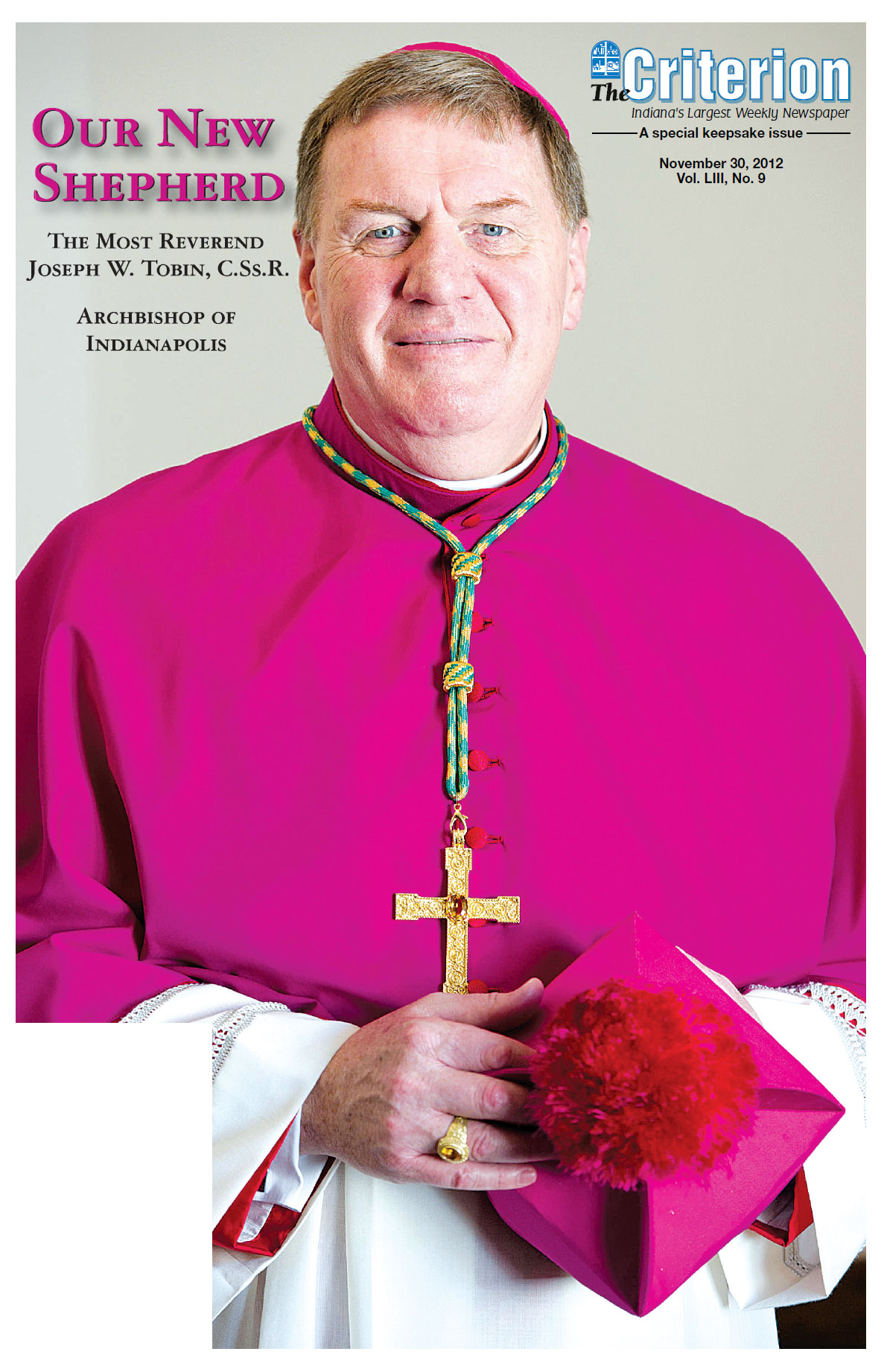
OUR NEW SHEPHERD: ARCHBISHOP JOSEPH W. TOBIN

W E L C O M E!


For two days last week I was among a select few invited to participate in the pageantry of the Installation of a beloved Redemptorist, Archbishop Joseph W. Tobin, who is now the Archbishop of Indianapolis.  This holy man is cloaked in spirituality – a palpable spirituality that he would surely deny.  He exudes a spirit of caring, sincerity, and love, and reaches out to others.  My heart soars when Archbishop Tobin speaks of his beloved parents and siblings. His mother and most of his twelve siblings attended both ceremonies.  His mother is fragile, but she was here and oh so proud of her oldest son.  It was touching to see him give Holy Communion to her and his other family members. 


At the end of the two days, I felt as if I had attended a two-day spiritual retreat.  A month ago we learned that we had a new archbishop coming to us after 12 years in Rome. Some said it was a demotion for him, but most of us knew -  without knowing how we knew -  that we were blessed with the appointment of Archbishop Joseph Tobin. We have been praying for over a year that the Lord would send us a good shepherd and He has.  Archbishop Tobin immediately flew to Indianapolis for a whirlwind few days to meet his flock.  During the few days that Archbishop Tobin was in Indianapolis, he celebrated Mass for the seminarians at Marian University; a Mass a The Little Sisters of the Poor and the elderly residing there; he was everywhere, but quietly. At his press conference he was prayerful and humble, humorous, and he paid homage to his predecessor, Archbishop Buechlein, who retired due to illness.  He thanked our Apostolic Administrator Bishop Coyne for guiding us almost immediately after he was named Auxiliary Bishop to assist Archbishop Buechlein.

And then came the ceremonies that began on Sunday, December 2, at a Solemn Evening Prayer for the First Sunday of Advent and Profession of Faith in anticipation of his Installation. At first, the Sunday evening service was to be open to the public, but then it became “by invitation only” due to the large number of religious, family members and friends of Archbishop Tobin. I had looked forward to attending because I knew I would never get an invitation to the Installation Mass – or so I thought.  A nun friend invited me and my house guest to that service. The service was joyful, lots of wonderful music along with the blessing of the Archbishop’s miter, his staff and his pectoral cross.   I walked out of the Cathedral feeling very blessed. And why not – I had just been in the presence of greatness – our new archbishop.

After the Mass we were invited to the Catholic Center (across the street) for refreshments.  What a spread that was! The company sponsoring the reception spared no expense. They apparently served everything they would serve for their own receptions, including hot hors oeuvres, miniature sandwiches, fruits, veggies, many desserts, and an outstanding bar. I chuckled and thought: only Catholics!

Two weeks before the Installation I learned that each of our 147 parishes was given two tickets to give away. I immediately told my parish priest that I would like an invitation to the Installation and he said he would look into it.  That sounded like “no way.”   It was not going to happen. I steamed and stewed! And I wanted one or two if possible. And then came the day that my pastor said I had a ticket! I almost shouted with joy! I then told my house guest that she could have it.  She adamantly refused and insisted that I go. However, she is blessed with the gift of gab, and managed to wheedle her own invitation to the Installation Mass.

The pageantry continued on Monday, December 2 at the SS. Peter and Paul Cathedral.  The Archdiocesan Choir, composed of singers from various choirs in the archdiocese, entertained as we waited for Mass to begin. The voices were angelic and the musical instruments from flutes to trumpets to kettledrums demanded to be heard and appreciated, and they were.  The procession began.  Altar servers were followed by the Knights and Ladies of St. Peter Claver; the Knights and Ladies of Malta, the Knights of Columbus, Knights and Ladies of the Holy Sepulcher, and an Irish group of women from the Orange Order.  Our hundreds of priests and seminarians processed in along with Indiana’s bishops, the few visiting bishops, the Papal Nuncio and finally our Archbishop Tobin.  He must have been nearly blinded by the flashes going off as he was welcomed into the Hoosier state. This saintly and holy man opened his Installation homily with a joke about his girth, and he saluted the largest Catholic group in Indiana – the Notre Dame football fans. He spoke lovingly about the Church reaching out to the “marginalized the forgotten, and those hurt by the Church.”  I have waited for years to hear such words from a bishop.  I was in love!

Some say Archbishop Tobin was removed from the Vatican because he was sympathetic to the U.S. nuns in the cross hairs of some at the Vatican.  His group was responsible for the nuns and their supposed “disobedience.”  I doubt that this holy man would ever have approved the insults and accusations hurled at the very nuns who taught many of us about our faith.  I was not a Catholic when I attended a Catholic school, but I never forgot it. During a very rough period in my young life – which lasted for 9 years – it was the Catholic prayers I was taught, and my mother’s promise that when I reached age 16, I could be baptized in the Catholic faith, that kept me sane. Despite the nightmarish and terrifying events thrust upon me, I knew that our Lord and His Mother were with me.  They have never failed me.

How I wish that each of my priests in prison had had a bishop such as Archbishop Tobin. I can’t wait to tell him all about our priests in prison and what I try to do for them and what they do for me.  I am so blessed to have them in my life. I will always feel that way despite their protestations that they do nothing for me while I do so much for them.  It is a blessing to me to serve these fallen angels who made mistakes in their lives.  Our Lord will judge them and He will judge me.  

And so I rejoice in he who we have awaited – Archbishop Tobin.  He is humble and comes ready to serve.  He has a forever home - here in Indianapolis.  We welcome our Shepherd, and I wish him our Lord's peace and blessings.


Wednesday, September 5, 2012

A POET- PRIEST WRITES FROM PRISON, PART II


if . . . in the greenwood. . . 

I'm in prison
I'm a "hardened con" after 8 years.
I'm a priest.
I want to stay here.
I don't want parole.
And I'm innocent.

My savings went to legal costs.
The Cardinal took away my pension.
The social security ended at conviction.
My car went to defray the cost of an expert witness.
The Church took away my livelihood.

My landlord took my apartment.
The Cardinal took away my medical benefits.
I'm anathema at the old priests' home.
The Cardinal won't tell me if I am excommunicated or not, so
I'm unwelcome at the prison Mass.
To dig, I am unable at 82 yrs. of age
As "the most hated man in Mass., one of the ten more notorious
criminals in Mass. history?" The "worst of the worst."
My life is in danger from the vigilantes.

I cannot stay with friends without making them targets.
The sex offender registry all but insures retribution from neighbors.

Is it not curious that the DA, now  the Attorney General, found
me harmless enough to go home with no prison time if I would
take a plea bargain and confess to 1456 rapes, or even to two?
Now ten years later I am surely less harmful.

Broken physically, socially, spiritually, religiously, vocationally,
my reputation destroyed, my integrity impugned, my golden years
squandered, parole would require yet another pound of flesh.

In prison I am so hated that I am kept out of sight even of
the general population -- protective custody.  Prison within a prison.

In any case it is useless to ask for parole since one is required
to admit his crime, show remorse and take the sex treatment
courses.  I have not even a smidgen of remorse for heinous acts
that never were.

Nearly deaf, hands shaking with familial tremors, a heart condition,
rosaea, limping from nerve damage from sciatica, allergies, skin cancer, 
high blood pressure, and cholesterol, I could not sleep under bridges
as do my compadres. My thyroid and my eyes have conditions which
require regular observation.

Let me die in prison, in solidarity with the countless other
innocents whose lives have been blighted or taken; the lynched,
the witches ...  while society consoles itself with two
great fallacies: "I can tell a guilty person" ... "Seldom do innocents go to 
prison."

 Modern science will disprove both.


S.P. in the Fields

Friday, August 10, 2012

Confessions From a Priest in Prison _ Part I

Dear Charlene,

You have been tireless in your championing the priests, innocent or guilty, and in that you are almost a voice crying in the wilderness. As the grateful recipient of your singular understanding of Christianity, I thank you.  How is it possible that nearly the whole bevy of bishops could fail in so basic a way?

You are the first to notice in print that even brother priests have generally abandoned the incarcerated. Is the veneer of Catholic morality so thin, so tenuous, that it dissolves by unspoken agreement? It may be that the bishops made some sort of pact, but surely the priests have done this on their own.

And you alone remembered that Charity is the queen of virtues. Or that Jesus Himself was at pains to require the visiting of the prisoner. Or do we have here the Unforgivable Sin which, like the Holy Grail, has had an elusive history?

You mentioned in your excellent essay: Forgiveness.  Have you seen or heard this word, this concept, applied somewhere in Catholic literature? I suggest it was stricken by the lawyers from clerical vocabulary in order to satisfy the hysteria of the mob.

You may want to think about a new problem: convicted priests who are about to reach parole dates.  They have no place to go unless their bishop intercedes.

I have a heart condition for which they want to send me to the hospital and to a specialist. I am refusing not the treatment which I want, but the ordeal. I can no longer sit on a stone bench in a cell with no magazines or books, chained around the waist, hands manacled, ankles manacled, for up to 8 hours.  I tend to fall asleep and I fear falling since I could not break my fall.  

Then too they stuff me in a metal box, sitting sideways, my long legs cramped, my back problems exacerbated, and drive off for the 45 minute horror.The wagon is similar to the ones you have seen in which they place animals who have been picked up by the dog (catcher). This ... chains and handcuffs...is called "elderly abuse" in society.  It is called "security" in here.

Your ministry is unique. Isn't that outrageous?

                                                                      Cordially,

                                                                       S. P. in the Fields


Thursday, July 12, 2012

ACCUSED PRIESTS BEGINNING TO SPEAK OUT


     by Charlene C. Duline


A few years ago I wrote an article about priests accused of sexual abuse. I did not argue as to their guilt or innocence.  I simply pointed out the obvious, that as Christians and as Catholics, we are to preach what our Lord prescribed – compassion, love and above all, forgiveness.  Some people thought I must be mad.  

No, I’m afraid that my opinion was not welcomed, not even in my own parish. However I did have the support of my pastor and that meant a lot to me. I felt so strongly about what our Church teaches us, that I wondered how our priests were treated in prison. I wrote to a number of them, and most responded.  As a result my prison ministry was born, and I am the better for it.

As the scandal continues, I notice that some parishioners have had enough of their priests being accused without proof of anything, and then thrown to the streets.  And they have begun to speak up for their priests.  Heretofore it had been VOTF and the SNAP folk acting up, acting out, and in effect, crucifying any priest who was accused.  Thanks to those same folk, the accusations grew exponentially, as did the amounts of money the bishops handed over on demand.  Meanwhile, the accused priests struggled alone in their agony with only our prayers to comfort them.  At least, I like to think that our prayers are of some solace.  Their brother priests are afraid to comfort them, to visit, or even to write to priests in prison. Acutely aware of this, and knowing of the hatred exhibited toward any accused priests, some of our priests left on the edge of the abyss either committed suicide, went to prison and lost contact with family and friends, or simply disappeared to live under a bridge as many priests without any wherewithal do.  Their bishops, no doubt, grinned and glad-handed each other: another troublesome priest gone.  Another crook paid off.  Another liar rewarded.  Another insatiable, money-grubbing attorney picked up another million dollars. Ah, the good bishops, simply doing the attorneys’ will:  handing out money faster than the parishioners could place it into the collection plate.

And then one priest decided to respond to the rumors and innuendoes about him and a woman.  As the gossip swirled about him, his parents, his previous position, he took the bull by the horns and issued a letter.  He hoped the letter would clarify actions of which he was accused.  Did it? Indeed not! Rather, it brought out the crazies by the hundreds!  Those who had never heard of Father began clamoring to be heard! It was outrageous! They knew diddly-squat about this priest, yet their mouths were open and gums flapping.  Like dogs, once one began barking, others joined in the barking until that was all that could be heard.  It was no longer about Father, but about every priest who was ever accused.  Were they clamoring for justice and honesty? No, they yapped just to hear themselves yapping! I’m not even sure that they heard themselves! And yet these good Catholics will go to Mass on Sunday, sit angelically, reverently process to receive Holy Communion, and once Mass ends, it’s back to yapping and damning all accused priests.  
 
None of those yapping has lifted a finger in defense of their priests. I realize the incentive of most parishioners is less than that of SNAP’s. In order to keep the lawyers interested, the hate groups have to shake the rafters (read: money tree) of the bishops, or their paid mouthpieces won’t get any of the parishes’ money. They have to find some poor bastard with no morals and little conscience, to lie and say that a priest groped him or her 40 or 50 years ago.  So while parishioners have less incentive to defend their priests than SNAP, defend them they must.  Or, soon and very soon, you will be in a Church all by yourselves. Who will be left to consecrate the Eucharist?  The bishops?  Dream on.

One priest who is not depending on his parishioners to defend him is a fiery priest in Philadelphia. Father DiGregorio was one of several priests accused and removed from ministry while their cases were being reviewed by the archdiocese. A woman had accused Fr. DiGregorio of abusing her 43 years ago.  He vehemently denied the accusation, and went on a radio talk show to defend himself.  He said,  “I hope I’m not being made a fall guy. I hope the diocese would not do that.”  Well, of course that was just wishful thinking and a prayerful hope.  The dioceses have shown that they can, and will, turn on a dime against their priests at the first whiff of a scandal. Father DiGregorio was removed, reinstated, and then removed again when Philadelphia authorities and the hate groups made their unhappiness known. Innocent or guilty, accused priests have the right to speak out – and a duty - to confront their accusers. The Catholic Church has forgotten the law of the land.


 Our priests have been silent for far too long.  It is past time for them to fight back.  They should not allow their bishops to send them away while accusers come out of the woodwork, as lawyers place ads in newspapers begging, begging people to come forward.  An accused priest should not slink away and never be heard from again. That leaves only the hate groups and their repulsive lawyers’ voices being heard.   With few exceptions, our bishops are shameless.  Surely they are seeing the results of their warped policy created in Dallas.  They are not listening to the canon lawyers who are skilled in Church law, or to the few good, decent bishops.  Is it any wonder that the grubby, greedy attorneys continue getting down and dirty in looking for people without morals to accuse innocent priests?  Common sense should tell us that all of the priests accused are not guilty. 

It is also time for those in the pews to get off their duffs and help their priests! For centuries we have revered our priests.  They give up a lot to minister to us as God’s priests. How often do we thank them, pray for them, or give them a hug?  I love our priests, and they will always be very special people to me.  Yes, some priests are sick and should not be ministering, and they are being removed from parishes.  But we cannot throw up our hands and say nothing when a good priest is accused of something from 30, 40 or 50 years ago. That is an outrage! That is when our priests need us, especially if there is no proof.  We have priests in prison who have served longer than someone who has murdered several people. U.S. prosecutors now target priests, and they have the help of SNAP’s vociferous mobs outside the courtrooms poisoning the minds and hearts of jurors and playing to the cameras.

It’s a new day.  Priests are beginning to put everybody on notice that they might go down swinging, but that they will be heard.  And beside them will be those of us who do not believe that every accused priest is guilty. It is time for parishioners to support our priests.  If not, soon there will be very few priests and it will be our fault for letting the hateful few – you know who you are - continue to drown out voices of reason, justice and compassion. 

Let's support and love our priests and let the devil take the hindmost!


Wednesday, June 13, 2012

GOING DOWN YONDER . . . THE SOUTH!


by Charlene C. Duline


Ten days ago I left for a visit to the South with my sidekick, Dolores.  I had never had a desire to visit the "South" as I thought of it.  I was born in Kentucky and I have visited several times, but for no more than 3 days at the longest, and I could not wait to leave.  I remember visiting as a 12 year old and going to a movie theatre with some friends.  The clerk at the theatre window took an unusually long time to wait on us and I let her know that she had customers - us!  I noticed that my friends hastily apologized and told the clerk that I was the grand-daughter of Creamus Small, a well-known and fairly respected black man in those parts.  Later, my friends chastised me for speaking up. "This is the 'South' they said. That meant nothing to me - then.

Much later I learned about the lynching of blacks in the South, and even later we learned that lynchings were still happening.  In 1955 the nation was jolted from its apathy by the murder of Emmett Till, a 14 yr. old teenager from Chicago.  Emmett was visiting relatives in Mississippi when he was accused of whistling at a white woman.  He was kidnapped from his great-uncle's home, beaten, shot in the head, and thrown into a river. Emmett's uncle and another black man risked their lives to identify the two white men who snatched Emmett from his family. Both men were smuggled out of Mississippi before they could be killed in retaliation. Emmett's body was returned to Chicago where his mother insisted that the casket be left open for the world to see what had been done to her son.  The two accused killers were found not guilty by an all-white male jury.  Later they bragged about killing Emmett.

I used to hear family members and other adults talking about what they experienced when they visited relatives in the "South."  They talked about the speed traps, the whites-only bathrooms, restaurants where they were refused service, having to enter public establishments through the back doors because only whites could use the front doors, the way whites spoke to them, and being extra careful of how they looked at or spoke to a white woman.  None of what I heard from them made me want to visit the South.  Somehow, as black people do, those talking about the South always laughed at the "close calls," or at their sly way of talking to whites in authority in the South.  They never seemed angry. To them it was simply a matter of surviving in the South.

In the '60s, when all hell broke loose, I saw and felt the hate on the faces of whites as little black children tried to enter so-called white schools.  I used to wonder what kind of people they were. And then my friend, Dolores, wanted me to visit the South with her. Frankly, I wanted to visit some southern cities to see the memorials to those who died during the civil rights struggle, but I decided long ago that I would have to see them on television or in books because I had no plans to subject myself to the whims of people who judged me solely on the basis of my skin color.  During my career I had met and worked with leaders of nations, the rich and the poor, and saw no need to subject myself to any people who thought of me and mine as little more than animals.  I let Dolores convince me that things had "changed down south" and I would be pleasantly surprised. We headed to Louisiana, Alabama, and Mississippi.  Good grief, I thought, if I survive this...

The days before we left, we found the planets unaligned. I had problems with my iPad and iPhone.  Apple said it was an ATT problem and ATT said it was an Apple problem, and I was thoroughly frustrated.  Dolores insisted that I was upset because I didn't want to go on the trip.  Truth be told, I didn't.  And the problems with my electronics only added to my distress.

We headed to New Orleans, a city I knew and loved.  That night we stopped in Fultondale, Alabama.  I never thought I would be in Alabama!  Fultondale is just outside of Birmingham.  Birmingham -  where four little black girls died when the KKK bombed their church.  As we drove through Tuscaloosa - I was flooded with memories.  Next came Meridian, Mississippi. Ole Ms! Jasper County - jasper brings to mind lovely gemstones thought to promote healing and relaxation, not so Jasper County - the site of KKK activity in firebombings. Memories came flooding back.


I thought of the three young men - James Chaney (a black Mississippian), Andrew Goodman and Michael Schwerner (both white, from New York)  -  murdered in 1964 in Philadelphia, Mississippi (just outside of Meridian, MS) because they were helping black people to register to vote. They were arrested by local police, released to KKK members who beat and killed them. They went missing on June 21, 1964, but their bodies were not found until August 4, 1964, buried in an earthen dam. Their killers were identified and went to trial.  They were always acquitted by all-white juries.  Finally, in 2005, on the 41st anniversary of their deaths, one man was convicted on charges brought by federal (not state!) officials. Edgar Ray Killen, an 80-year old white supremacist, and a part-time Baptist minister, was sentenced to 60 years in prison on three counts of manslaughter rather than murder which is what the prosecutor sought. The frail old man sat passively in his wheelchair breathing through an oxygen tube. The three men he killed (others implicated had died) were not allowed 41 years of life, not allowed to complete their education, marry, have children and grand-children.  No, Killen and other members of the KKK had enjoyed 41 years of a good life after orchestrating the deaths of the three young men. I know our Lord has forgiven him; it might take awhile for the families, friends and colleagues of the three who were killed, to do the same. Blacks and whites died to give us the privilege of voting, to eat at the same restaurants, to use the same facilities, and to have the same education in schools as whites had always enjoyed. Without the help of some caring whites, I doubt that segregation would have ended as soon as it did.  We owe a debt of thanks to a number of blacks and whites who gave their lives in the name of civil rights for all. May they rest in peace.

In New Orleans we stayed with an old friend of Dolores', Sr. Carla, at the Ursuline Sisters Convent.  What a building. What a history the Ursulines have in New Orleans.  This is the home of the Shrine of Our Lady of Prompt Succor (Quick Help).  They have a huge school with students from Kindergarten through 12th grade; impressive buildings and gardens. There was some damage from Hurricane Katrina, but their beautiful stained glass windows were spared, thanks they say to Our Lady of Prompt Succor. We visited the Amistad Research Center at Tulane University. They have my book, and a lot of material about Dr. John Crowley during his years in Selma, Alabama.  Dolores promised to send more materials for their Center. We visited the French Quarter, ate delicious beignets, and walked around a bit even though the weather was blistering hot.

That evening we went out to dinner with Sr. Carla, Sr. Donna and two other Ursuline nuns.  Sr. Carla wanted me to tell them all about my Peace Corps and Foreign Service experiences.  She encouraged them to ask questions.  After they asked two or three questions, and I answered them, they were off talking about things and people they all knew. Sr. Carla was chagrined. I understood the dynamics perfectly. It's comparable to someone inviting you to their home to see their vacation pictures.  After a few minutes your eyes glaze over and you find yourself talking about more mundane things.  So after a few minutes of hearing about the Burma bridge in the middle of my village of Quiquijana, they quickly - emphasis on quickly - moved on to things, things they could relate to.

A couple of days later we left for Biloxi, MS enroute to Dauphin Island.  Dolores told me that in the past Dauphin Island did not allow blacks on the island.  She related that a black couple who were friends of Carol, who owns the only bed and breakfast home on the island told her that when two black friends visited her, the husband enjoyed working in the garden.  A neighbor came over to ask Carol why she was bringing blacks to the island. Carol laughed at the neighbor and said, "That man is a federal judge. You'd better hope that you never have to go before him in court!" They thought she was importing blacks to work on Dauphin Island! Carol and I hit it off perfectly! She is a delight! She is as real as it gets!  She has worked in Central America, been a nurse, and cares for those less fortunate. She is warm, welcoming and generous with her time, her home, and her sharing.


Dolores also shared that years ago her husband, who had established a Catholic church on the island, took some black kids from Selma to the island.  As they walked along the beach, Dr. Crowley was told that blacks were not allowed on "our" beaches.  He was taken aback, but left immediately with the kids.

We went out to dinner one night and as I approached the restaurant I saw a sign on the door: "We reserve the right to refuse service to anyone."  Wow! I wondered what that meant. I was afraid to ask.  Later I mentioned it to Dolores.  She said it meant they didn't want people coming in barefoot or without tops.  Hmmm, why didn't the sign just say that?

We had a delightful visit to a dress shop where the owner, Marti, remembered Dolores from four years ago when Marti helped her select an elegant outfit to wear to a movie premier in Selma where Dolores' husband was being honored posthumously. Marti is a lovely, gracious, and giving woman.

On our last night, we had dinner in Gulfport, Mississippi at our hotel.  Near the end of dinner, Carol's husband, George, handed me a newspaper clipping showing a photo of him and Bull Connor, the infamous Commissioner of Public Safety in Birmingham. George was holding several police dogs as they lunged at a terrified black civil rights marcher. My heart wept. I didn't trust myself to speak. I could barely hear George saying that was a different time, and they were basically ignorant of what they were doing. I said nothing; I simply handed the picture back to him. I could not help but wonder why he showed me the picture. Dolores thought it was by way of an apology - of sorts.  The next day we said goodbye to Carol and George.  George hugged me and kissed me on the cheek. Dolores was floored.  She said she was surprised that he would hug, let alone kiss, a black woman.  I laughed. I am beyond being surprised anymore!

Despite the wounds to my spirit, I have come to see that our culture has come far in judging people by the goodness of their hearts and not the color of their skin. I saw blacks working at hotel desks, eating in restaurants, laughing and talking; doing what we take for granted, but what for them was a long, hard fought fight. I enjoyed  each and every person I met during those days down South.  Yes, I will visit the South again. No longer do the names of Biloxi, Meridian, Jasper, Birmingham, or Tuscaloosa cause my heart to skip a beat.  I know that God made fools and babies, and He protects both, and He loves both.  How can I do any less?


Tuesday, May 29, 2012


Bishop Takes Pawn: Plundering The Rights of a Prisoner- Priest

By Ryan A. MacDonald


Bishop John B. McCormack, Aux. Bishop Francis J. Christian and  Fr. Edward Arsenault, announce names of accused priests 
      of the Diocese of Manchester.     
                        
     
    "I do believe you will agree that we arrived at a point in our handling of these cases where canon and civil law are being eroded to the detriment and I think diminishment, not only of who we are as human beings, but of who we claim to be as Christians." (Catharine Henningsen, Voice of the Faithful Conference, February 5, 2004).


In October, 2000, Mr. Leo Demers - then Director of Engineering for WGBH-TV, the PBS-Boston television station that produces the news program, "Frontline" -  approached the Diocese of Manchester after being contacted by "Frontline" producers with an interest in the case of wrongly imprisoned priest, Father Gordon MacRae. Mr. Demers first called Auxiliary Bishop Francis Christian who flatly refused to discuss any aspect of the MacRae case. Shortly after, Mr. Demers was then summoned to meet with Bishop John McCormack. According to a sworn affidavit of Mr. Demers, Bishop McCormack informed him in this meeting: 

"What I am about to tell you must never leave this room. I believe Father MacRae is innocent and his accusers likely lied, but there is nothing I can do to change a jury verdict." 

Mr. Demers decided that he could not in conscience honor the secrecy demand of his bishop when two years later he learned that the bishop sent the case of Father MacRae to the Congregation for the Doctrine of the Faith in Rome seeking his canonical dismissal from the priesthood based upon no evidence other than the fact of his convictions. 


A New Hampshire attorney has corroborated the statement of Leo Demers with a statement of her own. Her sworn affidavit reveals that in December 2000, she sought a meeting with Bishop McCormack after learning of the possible interest of Dorothy Rabinowitz and The Wall Street Journal in looking at the MacRae case. According to her statement, both Bishop John McCormack and Auxiliary Bishop Francis Christian were present at that meeting, and both unequivocally stated their respective belief that Father MacRae is in fact innocent of the claims that sent him to prison. The two bishops informed the attorney of their intent to explore and fund an appeal of Father MacRae's trial and sentence. 

In 2001, Father Edward Arsenault, Bishop McCormack's "delegate for ministerial conduct," raised the following points in two confidential memos to the Bishop: 

"My suggestion is that we address the inequity in Gordon's lack of base remuneration over the last 8 - 10 years {a calculable number) . . . This would alleviate ... the burden from you for extraordinary measures and would be more consistent with Church law." 


"It was unfair of the Diocese not to assist Gordon with funding an appeal of his sentence leaving him with a public defender for his only remaining hope for appeal."

"We ought to admit to Gordon that we have no reason to doubt that the Grovers  [the accusers] may have embellished their testimony to suit their own purposes and that we have never supported Detective Mclaughlin's tactics.” 

The "base remuneration" never took place. However, other confidential memos to Bishop McCormack from other Diocesan personnel reveal their doubts about the trial testimony against Father MacRae, including these excerpts from a memo from Diocesan Attorney Bradford Cook: 

"Throughout this process it was obvious that all of the Grovers were expansive in their testimony and it was aimed at getting a certain result, and frankly none of the attorneys involved in the criminal or civil cases trusted their testimony to be completely accurate. Whether it was all trumped up or totally manufactured is impossible to know . . .  That it was embellished was clear." 

"Detective McLaughlin has been the instigator of many cases in the Keene area and seems to be a crusader on sexual abuse cases, engaging in questionable activities which border on entrapment on occasion." 

"As to the involvement of Father Scruton or anyone else at St. Bernard's, clearly there were several members of the clergy located at that church who had problems and it is impossible to discount that one or more of them may have been involved with one or more of the Grovers." 


THE BOSTON SCANDAL 
In a meeting in early January, 2002, Bishop McCormack promised the imprisoned priest that $40,000 in "non-donated funds" would be set aside to retain appellate counsel for him. Then suddenly the 2002 scandal broke out in Boston, implicated Bishop McCormack, and left Father MacRae outside the rapidly circling diocesan wagons. Bishop McCormack's subsequent memos to the priest continued to promise a defense, but with conditions. The memos called for MacRae's termination of any contact with The Wall Street Journal and Dorothy Rabinowitz before the diocese would agree to assist him further. Bishop McCormack's newer overtures promised help only if Father MacRae would agree to limit any inquiry to the length of his sentence and not the history and merits of the case or the convictions themselves.


Father Edward Arsenault contacted Father MacRae through the prison chaplain in 2002 with an assurance that the Diocese would retain Attorney David Vicinanzo to represent him. Reportedly, Father Arsenault asked the imprisoned priest to forward to his office all defense files retained by the priest. In December, 2002, Father Arsenault answered one of Father MacRae's letters with a statement that he "has not yet had an opportunity to discuss the materials you sent with Attorney Vicinanzo."
Months later, Father MacRae learned that his legal defense files were never given to the lawyer, and were instead taken by the state Attorney General's Office when serving a Grand Jury subpoena for priests' records on the Diocese. From that point on, Father Edward Arsenault and Bishop John McCormack both stopped responding to Father MacRae's letters. 


At the same time all of this was going on, Father Edward Arsenault and the Diocese of Manchester were deeply involved with negotiations with plaintiff lawyers for mediated settlements.  For a stunning review of what went on behind closed doors in these mediated settlements, please see an eye-opening article by Father George David Byers entitled, "The Judas Crisis...Follow the Thirty Pieces of Silver." 
When Bishop McCormack signed an agreement with the Attorney General's Office to publish the files of some 62 priests accused, a part of the agreement was that each priest would have a ten-day period to review and challenge publication of any files pertaining to him. Concerned that privileged legal documents and other materials produced post-trial by Father MacRae were about to be published, the imprisoned priest wrote to Father Edward Arsenault in January, 2003, asking that this ten-day review be afforded to him. He received no reply. 


Ten days after the files were published, in March of 2003, Father MacRae received a letter from an attorney for the diocese describing what he must do to obtain his files and review them before the release. The month-long delay in his receipt of that letter has never been validly explained to him.

After the publication of this vast release of files, Father MacRae wrote to both Bishop McCormack and Attorney General Kelly Ayotte protesting the publication of files that were fraudulently obtained by the diocese and published without regard for the priest's confidentiality rights. Bishop McCormack wrote that he tried to prevent the publication of files that were confidential, but was not successful. Attorney General Ayotte's representative wrote to Father MacRae stating that all files obtained by a Grand Jury in New Hampshire are considered confidential under law, but added that Bishop McCormack signed a waiver of confidentiality enabling all the accused priests' files to be published. 
In 2004, Bishop McCormack proposed in writing that he would like to meet with Father MacRae at the prison to discuss the norms under which he must send Father MacRae's case to the Congregation for the Doctrine of the Faith. Then the bishop cancelled this meeting and sent the case with no input from Father MacRae, with no defense, and without MacRae knowing any of the specifics of what was sent. 
In 2005, after Dorothy Rabinowitz published a two-part article exposing the clearly unjust trial and imprisonment of Father Gordon MacRae, officials of his Diocese, including his bishop, ceased all communication with him until 2008.

At that time, Bishop McCormack sent a letter to Father MacRae expressing his concern that he has "learned you have retained new counsel" in this case. Bishop McCormack wrote that he has retained counsel to represent him - though no one knows why the Bishop would need representation in Father MacRae's appeal. The Bishop's letter also detailed that he has commissioned lawyers to conduct a review of Father MacRae's trial for the Congregation for the Doctrine of the Faith. The Bishop's secret "review" bypassed all the lawyers and investigators diligently working on Father MacRae's appellate defense. Bishop McCormack has refused to divulge to the priest or his legal and canonical advocates the nature of that secret review.
Father MacRae has had no communication from his bishop since that 2008 letter. In a letter to Rome, Bishop McCormack asserted that since his imprisonment, Father MacRae has refused, through unnamed third parties, to have any contact with his Diocese or other priests.  MacRae has consistently maintained that he has never made such a request and has never learned the identities of these "third parties." It was upon review of the events I have described above that the late Reverend Richard John Neuhaus, Editor of First Things magazine, called the case of Father Gordon MacRae “A Kafkaesque Tale," the title of this editorial in the August/September, 2008, issue of First Things: 
A KAFKAESQUE TALE by Rev. Richard John Neuhaus 
"Among the many sad consequences of the sex abuse crisis are the injustices visited upon priests falsely accused. A particularly egregious case is that of Father Gordon MacRae of the diocese of Manchester, New Hampshire. He was sentenced to thirty-three years and has been imprisoned more than twelve years with no chance of parole because he insists he is innocent. 
I have followed the case for several years. Lawyer friends have closely examined the case and believe he was railroaded. The Wall Street Journal's Pulitzer Prize winning journalist Dorothy Rabinowitz published, on April 27 and 28, 2005, an account of the travesty ofjustice by which he was convicted. 
Now the friends of Father MacRae have created a website,www.GordonMacRae.net which provides a comprehensive narrative of the case, along with pertinent documentation Bishop John McCormack, a former aide of Boston's Cardinal Law, and the Diocese of Manchester do not come off as friends of justice or, for that matter, of elementary decency. You may want to visit the website and read this Kafkaesque tale. And then you may want to pray for Father MacRae, and for a Church and a justice system that seem indifferent to justice."
(First Things, August/September 2008)


"For we have made lies our refuge, and in falsehood we have taken shelter." (Isaiah 28:15)


To learn more about the troubling case of Father Gordon MacRae's false accusations and wrongful imprisonment, consult the following: 


http://www.thesestonewalls.com/about/